
Conveyancing has always been at the heart of what Blackhurst Budd does.
From the earliest days of the Blackhurst practice in 1876 through to the thousands of property transactions we handle across Blackpool and the Fylde Coast today, helping people buy and sell property has been a constant thread running through 150 years of legal practice.
But the conveyancing process of 2026 would be almost unrecognisable to a solicitor practising in Blackpool in 1876.
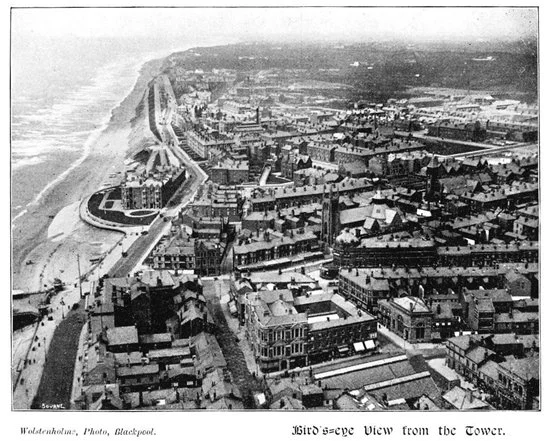
View from Blackpool Tower c. 1899
The changes over that period reflect not just legal reform, but the transformation of Blackpool itself, the rise of home ownership, the development of the mortgage market, and the impact of technology on almost every stage of a property transaction.
Property in Blackpool in 1876
When William Blackhurst established his practice in Blackpool in 1876, the town was still in the early stages of its rapid growth.
Blackpool had only just become a borough and the population was little more than 7,000. Large parts of the Fylde Coast that are now heavily developed were still far more rural in character.
Property ownership was also very different from today.
Most people rented rather than owned their homes, and buying property was largely limited to wealthier individuals, landowners, and the businessmen helping develop Blackpool’s growing hotels, boarding houses and commercial premises.
The legal process itself was slow and heavily dependent on paperwork.
There was no central register of ownership. Instead, ownership had to be proven through bundles of title deeds, often stretching back decades. Every transaction required a solicitor to physically examine those documents, tracing ownership through long chains of paper records and checking for anything that might affect the buyer’s rights.
A conveyancing file in Victorian Blackpool would have looked very different from the digital systems used today.
The arrival of land registration
One of the biggest changes in conveyancing came with the gradual introduction of land registration.
The Land Registration Act 1925 established the framework for a central register of land ownership in England and Wales, administered by HM Land Registry.
However, compulsory registration was introduced gradually across the country over many decades rather than all at once. In many areas, including Blackpool and the Fylde Coast, property transactions continued to rely heavily on traditional title deeds for years afterwards.
Compulsory registration did not fully extend across all of England and Wales until 1990.
That means solicitors in Blackpool spent much of the twentieth century working through a mixture of registered and unregistered land, with older title deeds remaining an important part of conveyancing practice for generations.
Today, by contrast, the majority of property transactions involve electronically accessible title registers and plans held by HM Land Registry.
Mortgages changed everything
The way people buy property has also changed dramatically.
In 1876, mortgage borrowing was far less accessible than it is today. Home ownership was not viewed as a normal aspiration for much of the working population, and finance options were limited.
Modern conveyancing on the Fylde Coast is closely tied to the mortgage market.
Most residential purchases now involve a lender, meaning the solicitor acts not only for the buyer but also for the bank or building society. This brings additional checks, lender requirements and regulatory obligations into almost every transaction.
The modern conveyancing solicitor must balance the needs of multiple parties while ensuring strict compliance with lender instructions and anti-money laundering requirements.
Searches and investigations
Victorian solicitors would also be surprised by the number of searches involved in a modern property transaction.
Today, buyers in Blackpool and across the Fylde Coast routinely receive:
Local authority searches
Drainage and water searches
Environmental searches
Flood risk information
Coal and mining reports in some areas
These searches provide information that simply would not have been available in 1876.
Modern conveyancing is as much about identifying hidden risk as it is transferring ownership.
SDLT and increasing complexity
Tax is another area that has become significantly more complicated.
Stamp duties have existed in various forms for centuries, but the modern Stamp Duty Land Tax regime bears little resemblance to anything a Victorian solicitor would have dealt with.
Rates, thresholds, surcharges and reliefs now create a level of complexity that requires careful analysis on almost every transaction.
What was once a relatively straightforward duty has evolved into a major part of the modern conveyancing process.
Technology and the modern transaction
Perhaps the most obvious difference between 1876 and 2026 is technology.
The Victorian conveyancing process relied entirely on handwritten documents, physical deeds and correspondence sent by post.
Today, transactions are driven by:
Email and digital communication
Online identity verification
Electronic document sharing
Digital case management systems
Increasing use of electronic signatures
Clients now expect updates instantly rather than waiting days for letters to arrive.
Even so, despite the technology, property transactions have not necessarily become less pressured. If anything, the pace and expectations of modern conveyancing have increased significantly.
Some things have not changed
For all the change over the last 150 years, some things remain remarkably familiar.
Buying or selling property is still one of the most important financial decisions most people will ever make.
Clients still want reassurance.
They still want clarity.
And they still want someone to identify problems before they become expensive mistakes.
That was true when William Blackhurst first practised on Church Street in 1876, and it remains true today.
150 years of conveyancing in Blackpool and the Fylde Coast
As Blackhurst Budd marks 150 years of legal practice in Blackpool, conveyancing remains a core part of what we do.
The systems, laws and technology may have changed dramatically since 1876, but our role has remained consistent: helping people across Blackpool and the Fylde Coast move forward with confidence.
For a century and a half, property has been at the centre of people’s lives.
And for 150 years, it has been at the centre of ours.