
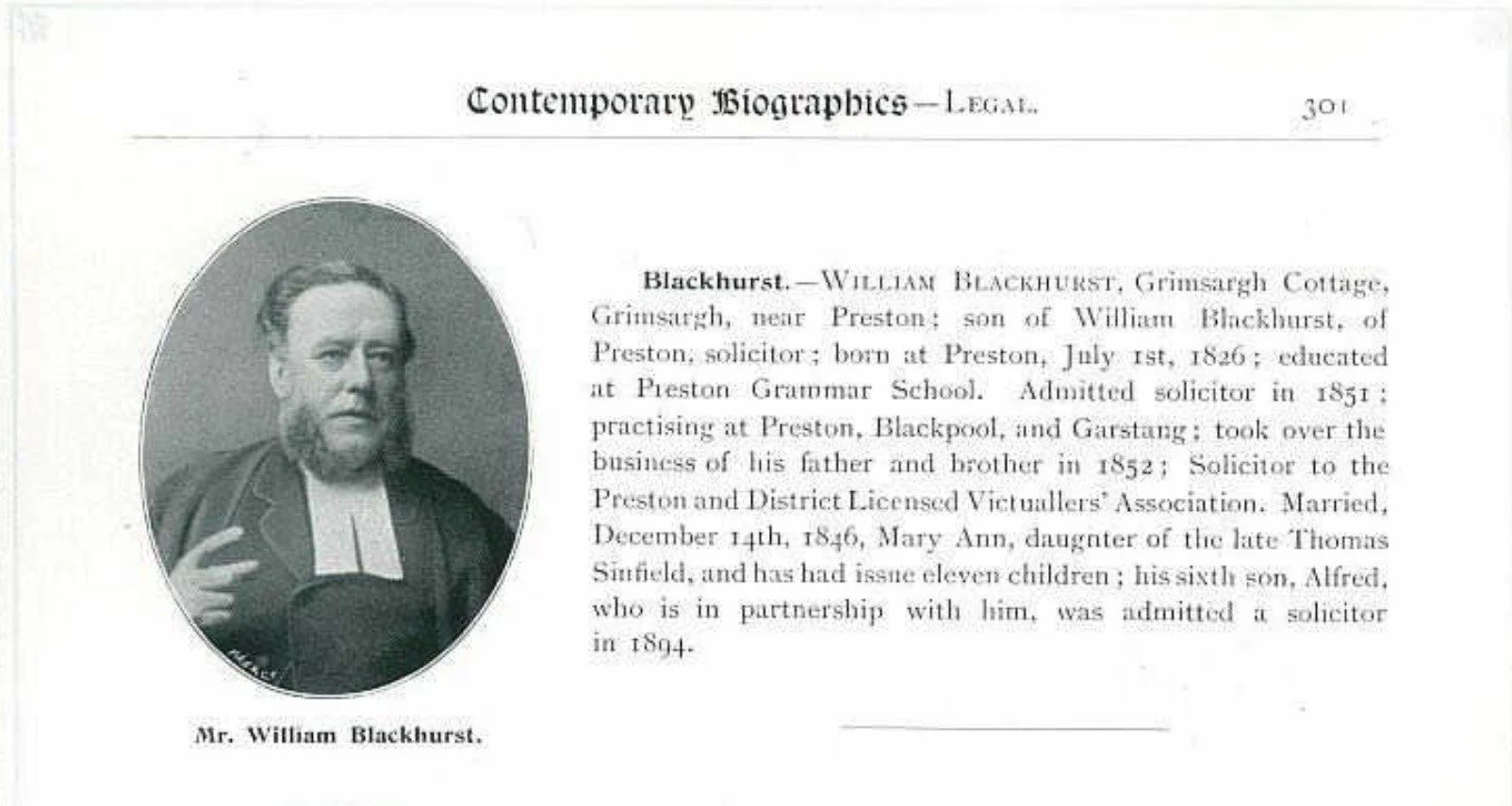
When William Blackhurst established his practice in Blackpool in 1876, he was entering a profession that was recognisable in name but very different in almost every other respect from the legal practice of today. The solicitor of 1876 occupied a distinct place in Victorian society, operated within a very different legal framework, and served a much narrower section of the population than a modern firm like Blackhurst Budd does today.
As we mark 150 years of practice in Blackpool and the Fylde Coast, it is worth reflecting on just how much the profession has changed.
Qualifying as a Solicitor in 1876
In 1876, the route into the legal profession was through articles, a form of apprenticeship in which a young man would be bound to a practising solicitor for a period of years, learning the work through direct involvement in practice. There were no formal examinations of the kind we would recognise today, and the quality of training depended largely on the firm to which an articled clerk was attached.
The Law Society had been established in 1825 and was gradually developing its role in regulating the profession, but the formal examination and qualification structure that now governs entry into practice was still in its early stages. The profession was, by modern standards, loosely regulated and entry was shaped as much by personal connection and social background as by demonstrated competence.
It is also worth noting that in 1876, the legal profession was exclusively male. Women were not admitted as solicitors until 1922, following the Sex Disqualification (Removal) Act 1919. The idea of a female solicitor, a female partner, or a female managing director of a law firm would have been entirely outside the frame of possibility for William Blackhurst's contemporaries.
Who Used a Solicitor?
In 1876, legal services were not accessible to most people. The cost of instructing a solicitor was significant relative to average wages, and for the majority of the population, legal advice was simply not something they could afford to seek. The solicitor's client base was drawn largely from the propertied classes, businessmen, landowners, and those with estates to manage or disputes serious enough to warrant the expense.
This had practical implications for the work a solicitor in Blackpool would have been doing in 1876. Property transactions, wills and probate for those with assets worth administering, commercial matters for the town's growing business community, and litigation for those who could afford it: these were the staples of practice. The broad range of services that a modern high street firm provides to clients from all backgrounds was not yet the reality of legal practice.
The Work of a Victorian Solicitor
A solicitor's office in 1876 was a very different physical environment from a modern law firm. All documents were handwritten or, increasingly, produced on early typewriting machines. Files were paper based. There was no telephone until the 1880s, meaning that communication with clients, other solicitors, and courts was by letter, often with a day or more between correspondence.
The conveyancing work that was central to Victorian legal practice involved the physical examination of title deeds, often going back many decades, to establish that a seller had good title to land. There was no central land register. Every transaction required a detailed investigation of the documents, and a solicitor needed to be skilled in reading and interpreting historical legal instruments.
Court work in 1876 took place within a system that had been significantly reformed by the Judicature Acts of 1873 and 1875, which consolidated the various superior courts of England and Wales into the Supreme Court of Judicature. These were significant reforms, but the practical experience of litigation, the travel to court, the reliance on oral advocacy, and the formality of proceedings, retained a distinctly Victorian character.
How the Profession Has Changed
The transformation of the legal profession over 150 years has been profound. Formal academic and vocational qualifications are now required for entry. The profession is regulated by the Solicitors Regulation Authority, with detailed conduct rules, client protection requirements, and oversight mechanisms that would have been unimaginable in 1876.
Women make up the majority of new entrants to the profession today. Legal aid, introduced after the Second World War, extended access to legal services to a much broader section of the population, though its scope has been reduced significantly in recent decades. Technology has transformed almost every aspect of how legal work is done, from document production and case management to the conduct of hearings and the registration of property.
The work itself has also expanded enormously. The complexity of modern commercial transactions, the development of employment law, consumer protection, data protection, and the range of regulatory frameworks that affect both individuals and businesses, means that the scope of legal practice today is vastly broader than anything a Victorian solicitor would have encountered.
What Has Stayed the Same
And yet, at its core, the role of the solicitor has not fundamentally changed. People still need clear, honest advice from someone they can trust, at the moments in life when the stakes are highest. The relationship between a solicitor and their client, built on confidence and professional duty, is as central to legal practice today as it was when William Blackhurst first opened his doors in Blackpool in 1876.
That continuity, across 150 years of change, is something Blackhurst Budd reflects on with genuine pride as we mark this anniversary year.